
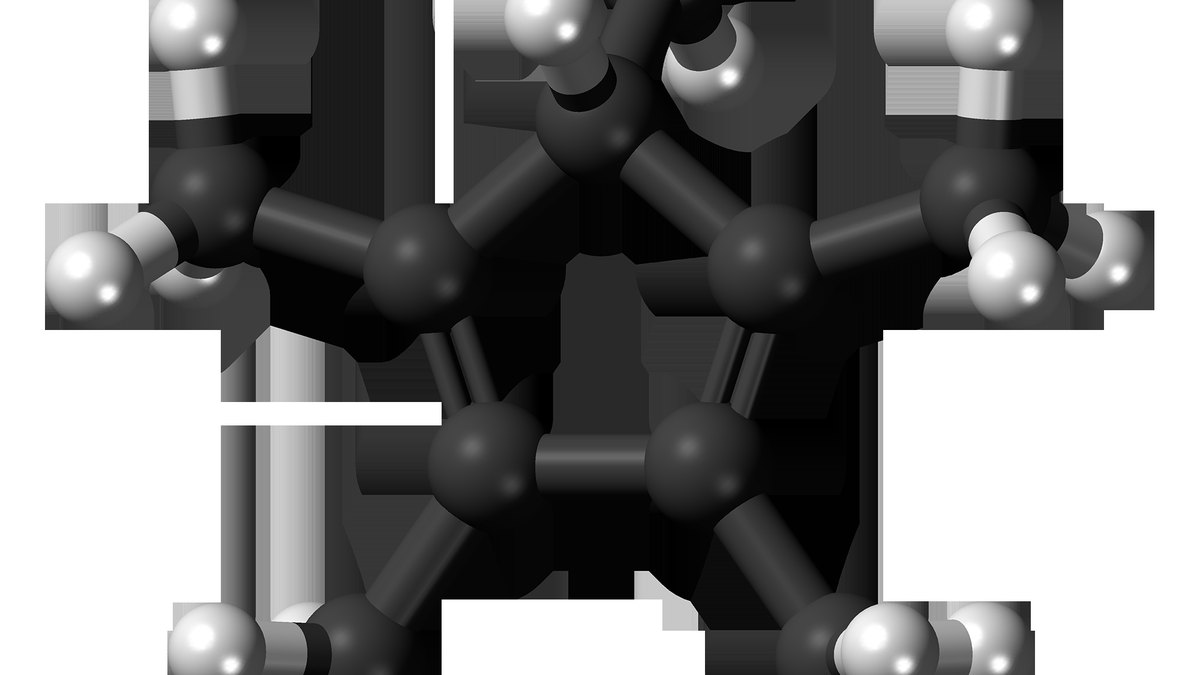
One sugar, two very different molecules
Polydatin — also written piceid — is the 3-β-D-glucoside of resveratrol: the same stilbene skeleton, with a single glucose unit bonded at the 3-hydroxyl position (C20H22O8, ~390 g/mol). It is the form the plant actually makes and stores; free resveratrol is largely what remains after that sugar is cleaved. In Polygonum cuspidatum (Japanese knotweed), grapes and peanuts, polydatin is usually the more abundant of the pair.
The glucose is not cosmetic. It occupies one of resveratrol's reactive hydroxyl groups, and in doing so it raises water solubility by roughly an order of magnitude and blunts the enzymatic oxidation and UV-driven degradation that make free resveratrol notoriously fickle to formulate. Reported figures put polydatin's aqueous solubility on the order of tens-fold above resveratrol's. The sugar also opens a different door into the body: rather than relying on passive diffusion, polydatin can enter cells through glucose transporters such as SGLT1, giving it an absorption route resveratrol does not have.
The redox chemistry, stated carefully
Resveratrol and its glucoside sit in the class of polyphenol antioxidants — molecules with electron-rich aromatic hydroxyls that can hand off a hydrogen atom or an electron to a radical and quench it. But direct radical scavenging is only the surface. Much of the interesting biology is indirect: these stilbenes nudge the cell's own antioxidant machinery.
Two hubs recur in the peer-reviewed work on polydatin. The first is SIRT1, an NAD+-dependent deacetylase — meaning its activity is tied directly to the cell's NAD+ supply. The second is Nrf2, the transcription factor that switches on a battery of antioxidant and detoxifying enzymes. The reported connection is elegant: activated SIRT1 deacetylates Nrf2, and deacetylated Nrf2 drives transcription of enzymes such as HO-1, NQO1 and superoxide dismutase. Studies describe polydatin engaging this SIRT1–Nrf2–ARE axis, and separately activating Nrf2 signalling, so that the cell makes more of its own defences rather than the molecule doing all the scavenging itself.
That redox picture is genuinely two-sided, and honest sources say so. At low exposures polydatin reads as protective, lifting glutathione and antioxidant-enzyme tone; at high concentrations, some cancer-cell studies report the opposite — a deliberate pro-oxidant shift, glutathione depletion and ROS accumulation. Redox is contextual, not a single direction, and the research reflects that.
Polydatin vs resveratrol: what the comparative studies show
The chemistry above explains why the glucoside should behave differently from free resveratrol. What does the direct comparative evidence say? The head-to-head literature is thin and entirely pre-clinical — two studies carry the comparison, and both are animal work:
| Study | Model | What it found |
|---|---|---|
| Wang HL, Gao JP, Han YL, Xu X — Phytomedicine, 2015 (PMID 25981921) | In vivo, animals | Polydatin and resveratrol interconvert in the body; in this comparison polydatin showed the stronger antioxidative effect of the pair. |
| Zhao G, Yang L, Zhong W, Hu Y — Frontiers in Nutrition, 2022 (PMID 35651514) | Mice fed a high-fructose diet (fatty-liver model) | The paper’s own title states its outcome: “Polydatin, A Glycoside of Resveratrol, Is Better Than Resveratrol in Alleviating Non-alcoholic Fatty Liver Disease in Mice Fed a High-Fructose Diet.” |
Read both rows with the labels they carry. These are animal and mechanistic endpoints; no human head-to-head comparison of polydatin against resveratrol was identified in the published record consulted for this page. Absorption is also a two-path story: polydatin can enter cells through glucose transporters such as SGLT1, but gut enzymes also cleave the sugar and release free resveratrol, so part of what reaches the blood is the aglycone either way. Whether the glucoside outperforms resveratrol in humans remains an open question.
Why it matters for research, and where it is fragile
Polydatin's appeal as a research compound is exactly its glucoside stability: it is easier to keep intact than free resveratrol. "Easier," though, is not "indestructible." Polyphenols are still oxidation-sensitive, still sensitive to light and to trace metal ions such as copper and iron that catalyse their auto-oxidation. Any serious attempt to study or store such a molecule — especially alongside redox partners like NAD+ and glutathione, which are themselves labile — runs straight into a preservation problem: how do you dry, store and later reconstitute a redox-active cargo without the process quietly oxidising it first?
Where Panacea Bio Chem works
Panacea Bio Chem works on the far side of that question — not on what a redox molecule does in a cell, but on keeping a redox-active formulation chemically intact from the bench to the point of use. Its ongoing, exploratory work touches several of the failure modes above directly:
- OxyDeplete is an oxygen-depletion approach — degassing plus a no-headspace design so there is no oxygen reservoir left to re-equilibrate against a labile antioxidant during storage.
- RedoxVault is Panacea Bio Chem's formulation-specific oxidative-protection architecture. Depending on the payload and formulation, it may employ lipid micro-reservoirs, protective microcompartments, compatible antioxidants, redox-active sacrificial excipients, trace-metal controls, chelation or other qualified mechanisms. Oily or lipid micro-reservoirs are one possible implementation, not the universal definition of RedoxVault™. For a polyphenol like polydatin, where the enemy is copper- and iron-catalysed auto-oxidation, that may mean isolating the molecule in protective lipid compartments and controlling trace metals rather than any single fixed recipe.
- PolyGluNAD is an exploratory cake identity that co-locates NAD+, reduced glutathione and polydatin, balanced by a trehalose glass — a redox platform that mirrors the very SIRT1/NAD+/glutathione biology the literature describes, held as a directional research target rather than a finished product.
None of this asserts a result. The direction Panacea's research points is simply this: a redox molecule is only as useful as the state it arrives in, and preserving that state is its own discipline.
The takeaway
Polydatin is a small, telling example of how one sugar reshapes a molecule — better water solubility, better stability, a distinct absorption route, and a redox biology that runs through NAD+-linked switches rather than brute scavenging. The science is real and still unfolding. Keeping such a molecule intact long enough to study it, and later to use it, is the quieter half of the work — and it is the half a preservation lab is built to explore.
Frequently asked
What is polydatin?
Polydatin (piceid) is the 3-β-D-glucoside of resveratrol — the same stilbene with a single glucose unit at the 3-hydroxyl position (C20H22O8, ~390 g/mol). It is the form knotweed, grapes and peanuts make and store, usually more abundant than free resveratrol.
How is it different from resveratrol?
The glucose raises water solubility by about an order of magnitude, blunts the oxidation and UV degradation that plague free resveratrol, and opens a glucose-transporter (SGLT1) absorption route resveratrol lacks.
How does its redox biology work?
Mostly indirectly. Polydatin engages the SIRT1–Nrf2–ARE axis — SIRT1 is NAD+-dependent, and activated SIRT1 deacetylates Nrf2, which drives antioxidant enzymes (HO-1, NQO1, SOD). It is protective at low exposure and pro-oxidant at high concentration in some cancer-cell studies.
Why is it fragile to store?
Polyphenols remain oxidation- and light-sensitive and are catalysed to auto-oxidise by trace copper and iron. Drying and storing a redox-active cargo without oxidising it first is a genuine preservation problem.
Is polydatin a medicine?
No. It is a naturally occurring plant compound studied in basic redox biology. This page is a scientific description — nothing here is medical advice.
Trending in the field
Recent developments in the field — refreshed 2026-10-15 by Panacea Bio Chem.
- Polydatin alleviates vascular calcification via the TP53/PI3K/AKT axis — PubMed, 2026 Oct 9
- Polydatin Encapsulated in Human Serum Albumin Nanoparticles Attenuates Oxidative Damage and Protects Rotenone-Induced Neuroblastoma cells — PubMed, 2026 Oct 3
- Polydatin mitigates cigarette smoke-induced pulmonary apoptosis by regulating Bim via FoxO3 post-translational modifications and modulating the gut microenvironment — PubMed, 2026 Aug 3
- Bioactive constituents from Dioscorea bulbifera L. rhizomes with antioxidant and α-glucosidase inhibitory properties — PubMed, 2026 Sep 30
References & further reading
- Polydatin (piceid) — overview. Wikipedia: Piceid · Wikipedia: Resveratrol.
- SIRT1, an NAD+-dependent deacetylase, and the NAD+ connection. Wikipedia: SIRT1 · Wikipedia: NAD+.
- Nrf2 and the antioxidant-response (ARE) pathway. Wikipedia: NFE2L2 (Nrf2).
- Wang HL, Gao JP, Han YL, Xu X. Comparative studies of polydatin and resveratrol on mutual transformation and antioxidative effect in vivo. Phytomedicine, 2015. pubmed
- Zhao G, Yang L, Zhong W, Hu Y. Polydatin, A Glycoside of Resveratrol, Is Better Than Resveratrol in Alleviating Non-alcoholic Fatty Liver Disease in Mice Fed a High-Fructose Diet. Frontiers in Nutrition, 2022. pubmed
- Karami A, Fakhri S, Kooshki L, Khan H. Polydatin: Pharmacological Mechanisms, Therapeutic Targets, Biological Activities, and Health Benefits. Molecules, 2022. pubmed · doi:10.3390/molecules27196474
- Polydatin pharmacology & redox biology — primary literature. PubMed · doi:10.3390/molecules27196474.




